Earlier this week, Norm was going through a stash of saved birthday and anniversary cards, and he came across a list of Life Goals I had made on Sept. 6, 1975. Back in those days, it was common for a workshop leader to tell you to write down your goals if you wanted to accomplish them. So on or about Labor Day of that year, while I was working part-time at a newspaper and still homesick for the Ozarks and the Rocky Mountains after moving to the Big City, I made a list of 44 items in green ink on a blank church bulletin.
Of course, I lost track of the list and hadn't seen it in at least a decade, but a month or so ago I had wondered about it. Maybe that thought is what helped bring it to the surface. Anyway, I had a good laugh at some of the items, and felt nostalgia for some others. If I had worked at the list and accomplished one a year, I could look forward to total victory sometime in the year 2019, or around my 76th birthday! But the truth is, some of these goals have long been out of reach, and others have been supplanted by different dreams. Here is the list, with those that I did accomplish marked with an asterisk:
1. Climb to the top of Gray's Peak, Colo. (I got to within 1300 feet of the summit in 1972 and wanted to go back and finish the job. Alas, not.)
2. Camp in the Bridger Wilderness in Wyoming.
3. Visit Alaska and Hawaii.
4. Visit all 48 contiguous states. (So far I've made it to 25.)
5. Drive a truck.
6. Publish a book.
*7. Float on the Current River and the Buffalo River.
8. Publish a newspaper
9. Ride cross-country on a bicycle.
10. Have two children.
11. Live on a farm of 10 acres or more.
12. Go up in a hot air balloon.
13. Visit Yellowstone, Sequoia, and Grand Canyon national parks. (I went to the Grand Canyon with my parents in 1960, but wanted to go again and to the North rim this time.)
14. Ride the Delta Queen to New Orleans. (After taking the Huck Finn to the JB Bridge, I think that's as far as I'll go.)
15. Hike the Appalachian Trail. (Will maybe a mile, if I can manage it, count?)
16, Go on a cross-country ski trip.
*****17. Make a quilt. (At last, something!)
18. Refinish an old piece of furniture.
19. Have a craft or yarn shop.
20. Visit Mexico.
*21 Visit Ireland.(I was there in 1967. But I want to go again.)
23. Lead a Girl Scout Troop.
23. Own or manage a camp.
24. Become a campcraft instructor.
25. Qualify for Red Cross First Aid or Lifesaving. (Got the first aid, also CPR. No water stuff.)
26. Get a first class radio license.
27. Operate a ham radio.
28. Learn how to tune up a car. (Kind of obsolete now. I did manage to gap some spark plugs.)
29. Read all the works of William Faulkner.
30. Raise Christmas trees.(On that 10-acre farm, no doubt.)
31. Study herb lore and raise a herb garden. (Do pots of mint and lavender and basil count?)
32. Build a greenhouse.
33. Build a tree house.
34. Trim a tree.
35. Raise all my own fruits and vegetables.
36. Become a vegetarian.
37. Go on a round trip to the moon. (Remember, the first moon landing was only 6 years earlier.)
38. Write a novel.
39. Win a literary prize.
40. Visit an Indian reservation.
41. Visit the birthplaces of my parents, grandparents and great-grandparents. (So far, the parents.)
42. Get a copyright or a patent.
43. Build a log cabin.
44. Ride a train through Glenwood Canyon, Colo.
Wow. What ambition. I'm amazed that I once had such athletic inclinations. A lot of these ran to outdoor activities, or gardening, or self-sufficiency, which was a big theme in the 1970s. As you can see, there aren't many asterisks. But I did set other goals and accomplish some of them. That is a story for another day. The photos here are from the campus of my alma mater, the University of Arkansas. Near the old Student Union, a bald cypress that was there in the 1960s during my student days still broods over the sidewalk, and it now has a plaque at its base, for special recognition of its longevity. If trees could only talk, the tales it could tell! And the Arkansas tradition of Senior Walk continues, with the name of each graduate etched in concrete. I'm there twice; below is my name from 1966 when I got my master's degree. It's not yet an epitaph; there's more to go.

 From Don and Kay in Garden City comes this photo of one of mom Linville's amaryllis plants (more correctly, a descendant thereof) blooming in their sunroom on Monday of this week. As Don noted, just in time for her birthday. Bertha Williams was born on this date 101 years ago in a Western Kansas dugout. A true pioneer, she loved flowers and grew an amazing variety of them despite the challenges of surviving in a a dry, windy, hot, freezing, dusty, unpredictable climate. The amaryllis was only one of the beautiful things that she passed on to her children and their children over the years. And she was the best mother-in-law I could have ever hoped for. Nine years since her passing, we still miss her.
 In Central Missouri, there is a retreat center known as Rickman Camp and Conference center, which is owned by the regional Disciples of Christ church. I spent the weekend of March 23-24 there with 21 other women. The rest of the story of the retreat can be found on Home Stories. About 11 a.m. on Saturday, I explored the prayer trail, and found all kinds of small details and wonders to photograph as I walked. I was practicing being in the present moment, trying to be open to what my heart or soul might have learned during the retreat. Our leader, an artist, talked about coming back to her art after many years, finding it a gift she could use for ministry.
 Over the years I have explored many gifts, including writing, quilting, photography, and others. But one sensibility I've had since I was very young is an appreciation for the natural world and a desire to experience its myriad changes and moods.
I've collected rocks since I was in grade school (but I left this one in place after taking its picture.). I've identified trees and flowers and birds and tracked the stars.
 The night before I took this walk, I had gone outside for half an hour to just sit on a bench in the darkness. Something the leader had shared with us had reminded me of accounts I had read of the old Cherokees and other Native Americans who said they needed physical contact with the ground in order to connect with the Great Spirit. I took off my shoes and socks and let the coolness of the ground seep up through my feet.
 As I sat absorbing the silence, I began to hear the peeping of little frogs that come out as a first sign of spring. The next day when I shared that, people seemed surprised that anyone would know what had made the sound. I'm wondering if this is a gift I can use again at this stage of my life. What does it mean that I see the delicate web of a spider in the woods by the prayer trail, or a lichen-covered stump?
 A hillside near an outdoor chapel on the Center's grounds is covered with huge, ancient cedar (actually, juniper) trees. They were about to bloom and release a ton of pollen into the air, much to the dismay of anyone with allergies. Even the tiniest thing in Nature can have a profound effect on humans. After I came in from sitting in the night, my feet in contact with the ground, my ears open to the silence, I wrote this:
 All the world is quiet except for the buzzing of a street light, the click of a cardoor and someone rolling a suitcase up the walk. And a far off roar of traffic on the highway. And the FROGS! So faint...spring peepers, that falsetto soprano chorus... first night sounds of Spring.
I have to be grounded--I could never live in a high rise, or even on a second floor with a lovely deck. I need the ground to walk on. If only I could be limber enough again to sit down on it, kneel on it, lie on it, and feel the energy of the Earth flow into me, rekindle my spirit. BUT I'm not yet ready to be IN the ground--because I also need to see the sky.
 Some 30 or 40 years ago, we hummed a Beatles tune: will you still need me, will you still feed me, when I'm 64? That was the age at which we youths expected to become old folks, tottering a bit, needing someone to monitor our meds and take away our car keys if we strayed too far off the center line.
Today, I turned 64. That's 8 times 8, as I learned my multiplication tables in third grade. But as I thought about it, I decided to look at my life so far as 4 times 16. Once, 20 years were supposed to define a generation, but today, with the rapid rate of technological change, a generation is closer to 16 or 18 years. So I tried to break the years into generational, or 16-year segments.
1959--My sixteenth birthday. Most girls of my generation expected a special party, but nothing like the "Sweet Sixteen" social coming-out galas that are commoplace today. That year, there was no party. My grandmother McElyea died one day before my 16th birthday, and her funeral was held a few days after. Mary Paris McElyea left me a legacy of a trunk full of hand-made quilts and a fistful of prized family recipes. I wish I could have claimed additional items at her estate sale, like her full set of Fiesta Ware. But mother did save for me her Apple Blossom china and her Vintage pattern silver plate. When I was about 7, Granny Mc helped me make a simple doll quilt by hand. Unfortunately my desire to make quilts of my own didn't emerge until the late 1980s, some 30 years after her death. But I inherited any talent I have with a needle from her. (The wall quilt above is a Lone Star I made a few years ago that was exhibited at the 2005 Flower Valley Quilt Guild show.) The one bright spot of this birthday was getting a phone call that told me I had been selected to attend a national Girl Scout encampment, called Roundup (kind of like the Boy Scout Jamboree, except these Roundups don't happen any more) that would be held in Colorado Springs in July. So it was a bittersweet birthday when I was 16.
1975--My thirty-second birthday was observed in St. Louis, where I was unemployed and taking an editing class at a local junior college in order to network and try to find a job in journalism. In the 16 years since 1959, I had gone to that Girl Scout camp, attended college and earned a master's degree, obtained a college teaching job in Kansas, met Norm, gotten married, moved to Denver while he went to seminary and moved to St. Louis when he got a publishing job. That was an action-packed 16 years. My dog I had had since I was 10, Rags, had died in 1969, and later that summer, on our first wedding anniversary, Norm and I adopted a puppy we named Sandy from our friends John and Nancy Sanders, and Sandy would brighten our lives for almost 17 years. In March of 1975, I got a proofreading job at a weekly newspaper, which was the start of my journalism career.
1991--How did I get to be 48 so soon? I'm almost 50! I really can't remember how I celebrated this birthday, except later that month, Norm had a wreck on his way to work and I waited in the emergency room while they verified a couple of broken ribs. These were stressful years involving work and my parents' health. In 1989 my father died. My mother had difficulty coping with the details of living alone, but she wouldn't consider moving to live with us, or to a senior apartment. Check stubs from those years reveal that I flew to Tulsa about once a month on weekends to help her with insurance forms, balance her checkbook, stock up on TV dinners, go to church. I had been teaching writing courses at a university since 1987, after working in newspapers, magazines and public relations. Norm had been pastor of a church since 1985. Sandy had passed away in 1986 and later that year we adopted Suzie, a 5-year-old Lhasa-Poo cross, who would be with us until 1995. The 1990s were a dizzying round of emergency trips to see our parents, frantic grading of final exams while someone was in the hospital, all while trying to maintain friendships and a life. By the end of the decade, we had said farewell in this life to both of Norm's parents, one of his brothers, one of his sisters and my mother.
2007--Here I am, at 64. When I turned 50, I got my ears pierced and started collecting earrings. I kept on teaching and started advising a college newspaper in 1994, the same year mother was diagnosed with Alzheimer's. I joined a quilt guild and attended a summer writing workshop in nonfiction. Norm and I began taking short trips to state park lodges where we could indulge in bird watching. In 2003, Norm retired from preaching. In 2006, I retired from full-time teaching but kept a part-time job with the student newspaper. I started writing what I call the Memoir Project and if I finish it, it will be a family and personal history, starting with my four great-grandmothers, 3 of whom were known to be quilters. And we have been blessed with surrogate parenthood: for at least a decade, we have had Doug in our lives as the son we never had. And now we have his partner Matt, also, and their dog Sam. We have enjoyed volunteer projects and have lots of travel plans.
Where from here? Well, if the past is any predictor, the next 16 years should be quite a trip. If I'm still blogging in 2023, I'll be 80, and I'll let you know how the 5th generation is doing.
 For the month of November, this cornucopia has been the seasonal banner at our front step. Soon it will be time to put up something suitable for Christmas, but the image of natural abundance in the picture reminds me that I need to make a list of some of the things I am most thankful for.
Back in 1999, I read a small book titled Simple Abundance by Sarah Ban Breathnach. The premise was simple...too simplistic, some would say. The idea is to become aware of one's blessings, to cherish the present moment and see what one has to be grateful for. Cultivating this practice of gratitude has become my most reliable spiritual discipline, since I tend to falter when it comes to some of the others. And even though the Simple Abundance idea has gone on to become a huge industry, that basic practice of gratitude...finding five things a day that I am thankful for, each day, without duplicating yesterday's list...has sustained me when I have felt overwhelmed by work or commitments, saddened by events beyond my control, discouraged by my own weakness, or just plain tired. If I were to compile a condensed Simple Abundance list for 2006, it might include the following:
- Retirement, and the joy of sleeping in--sometimes.
- Water exercise
- Reading club
- Blogging
- Seeing Carnall Hall restored and thriving (see account on Home Stories)
- Walking on the beach in Ft. Myers, Fla.
- Doug's PhD hooding ceremony.
- All of Doug's family and Matt's family and many friends at our house for his graduation picnic in May
- Being able to walk right after arthroscopic knee surgery
- The hum of neighborhood generators through the night during our 5-day storm blackout.
- The kindness of neighbors.
- Hummingbirds at the feeder
- Quilt stamps to put on letters
- Online banking to save postage
- Sloppy Poodle kisses from a pup named Sam
- The best neighbor in the world, Barb, to share a driveway with, and her 15-year-old terrier, Barnabas.
- All of the Linville sibs and many of their families at the reunion in June
- The World's Largest Ball of Twine is really that.
- Highways
- Non-stop flights
- high Speed Internet Access, and the means to pay for it.
- The Cardinals win the World Series
- My student newspaper staff takes 2nd in the nation
- A 13-year-old Van keeps truckin'
- Sunlight
- Rain
- Our outdoor and indoor garden
- Christmas Cacti blooming two months early
- 250 Trick or Treaters on Halloween
- Passing the Peace on Sundays at Compton Heights
- Norm
- Life, here and now, every day.
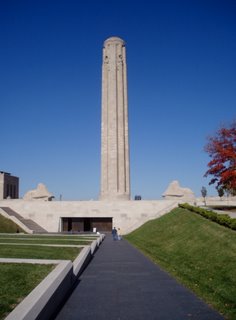 November 11, 1918-- Armistice Day. The truce that ended World War I, or as it was known in that long-ago time, the War to End All Wars. Down through the years, the date has become a federal holiday, and now is known as Veterans Day, to honor all those who have served in all of the armed services in any of America's Wars since WWI. The photo is of Kansas City's striking Peace Memorial, recently renovated and re-opened to the public. It has a new museum underneath. Originally known as "the War Memorial," it was built to commemorate WWI. At some point, Kansas Citians renamed it to honor the 20th Century's quest for peace instead.
At at time when our nation is caught between a rock and a hard place in Iraq, it might be a good time to pause and think about the sacrifices of those WWI doughboys who went to Europe and endured unimaginable wounds, mustard gas, and worse. Every time America has to go to war, personally I would hope that the exercise would leave the world a better place, in addition to securing greater security for our nation and a better climate for peace. They say that only 12 to 15 veterans of WWI are still alive, and most of them are over 100 years old. Veterans of WWII are dwindling, too. My dad, whose draft notice appeared in the mailbox the same morning I was born in 1943, has been dead for 17 years now. When I sorted through his keepsakes I found his Army field manual and several medals for expert marksmanship. An old knee injury from high school football kept him out of the Infantry, and a field surgeon sent him home to my mother and me just before his outfit left to attack Rommel in North Africa. Because he didn't see combat, he wasn't a veteran, but he was proud of his service. If he were alive today, he would be watching the televised news reports from Iraq and Afghanistan and probably would say something to the equivalent of "what are they thinking?" in regard to the political leadership, and he would be supporting the troops in their impossible mission. I can do no less than that.
What if there were a Reconciliation Commission for Iraq? The mission there today has become stabilizing the nation so that the Iraqi government can function without being overwhelmed by various factions, including insurgents and warring religious and ethnic sects. The situation might be better handled if the troops could be augmented by a proactive effort to begin to heal the wounds in that country, an effort led by the Iraqis themselves. After apartheid was ended in South Africa, a Reconciliation Commission investigated the various imprisonments and wrongs that took place and helped people find solutions that didn't involve civil warfare. Would something similar work for Iraq? Is anyone willing to try some genuine peace-keeping in addition to maintaining a security force? On this Veterans Day, former Armistice Day of the war to end all wars, it's worth a thought.
 Yesterday I tried to write an Election Day post, but the upload feature wasn't working. Probably all those bloggers out there hogging the bandwidth! This photo is of a St. Louis landmark, the Old Courthouse. It was a working federal courthouse throughout the 19th Century and into the 20th. The slave Dred Scott lost an appeal for his freedom before the United States Circuit Court meeting in this building in 1854. A 25-year-old Hungarian immigrant named Joseph Pulitzer bought a newspaper in a bankruptcy sale on the steps of this courthouse in 1878, and merged it with another one he owned to found the St. Louis Post-Dispatch. Now we all know that the Dred Scott decision was ultimately superseded by President Lincoln's Emancipation Proclamation, and the ratification in 1865 of the 13th Amendment to the Constitution. And earlier this year, the Pulitzer family sold the Post-Dispatch to another publishing group. My point: even the great moments of history don't last forever.
I like the clean, classic lines of The Old Courthouse in downtown St. Louis because it reminds me of the somewhat classical ideals on which our country was founded: life, liberty and the pursuit of happiness, a rule of law, an abhorrence of dictatorship or monarchy, equal justice for all. And regularly we hold elections to choose our representatives to carry out these ideals. Since my first election in 1964 (which is the only time I ever voted absentee) I have missed only one opportunity to vote wherever I have lived. Often I find myself on the losing side (I start out in blue states and they turn red, seemingly overnight, after I move there) but I have never subscribed to the cynical theory that my vote doesn't count. You couldn't keep me home on election day with a flotilla of tanks in the street.
Last night I stayed up to watch the election returns. It was a late night; the victor in Missouri's contested Senate race spoke after 1 a.m., followed by a concession speech from the incumbent. The margin of victory was finally about 3 percent, although at the time Claire McCaskill was declared the winner, only about 25,000 votes separated her from Jim Talent. This is one of those extremely rare years that "my" candidate actually won, but I have to confess I have been following the excitement of the political process since I was about 9 years old.
During the hot summer of 1952 in Oklahoma, I remember the political conventions being broadcast, seemingly gavel-to-gavel, on radio (we didn't have television until I was 14.) I would be sent to bed at the usual time but my parents kept the radio on, and I kept sitting bolt upright in my bed, with the door ajar so I could listen to the speeches and above all, the roll call votes. There was something thrilling about hearing "and the Great State of Illinois....casts its ...votes for...Governor Adlai Stevenson!" Or the chants of "I Like Ike" coming from the Republicans as they nominated the general who promised to "go to Korea" and end that conflict. My childhood diary entries reveal that summer I became hooked on politics and that interest probably foreshadowed my interest in journalism. Many of my acquaintances are suspicious of those network news pundits who sit at what nowadays resembles an aircraft carrier control desk and gleefully track the Red and Blue states. Last night their excitement was probably interpreted as a liberal bias. Some of them are liberal, to be sure. But most of the excitement is from an adrenaline rush of reporting on something that is ever-changing, quick moving, novel and historic all at once.
There is nothing else on earth like an American election, even with all the flaws in our political system that surface from time to time. Yesterday morning I spent an hour in a line to use one of the three brand spanking new working computerized voting machines crammed into our tiny precinct headquarters. It was not yet noon and I was voter number 349 in a village of 1500 souls, not all of them of voting age. Turnout in our county was close to 70 percent. People cared about the propositions on the ballot, especially those to protect stem cell research and to raise the minimum wage. They also cared about their local legislators and the Senate contest.. One woman using a walker was attended by her son, a 50-ish fellow in a gray sweatshirt who talked with us in line. I'm pretty sure he didn't vote the way I did, but I liked being there in line with him, anyway. And he had brought his mother to vote. Another man came in a wheelchair. Young people came on their lunch hours from work. Black and white, old and young, Republicans and Democrats and Libertarians and Independents. Americans. As deTocqueville noted: here, the people rule. I can't wait for 2008.
 Despite the bank and postal holiday we observed on Monday, today, October 12, is the real Columbus Day. It's the date I learned in school, and that was forever sealed in my mind because October 12 was also my mother's birthday.
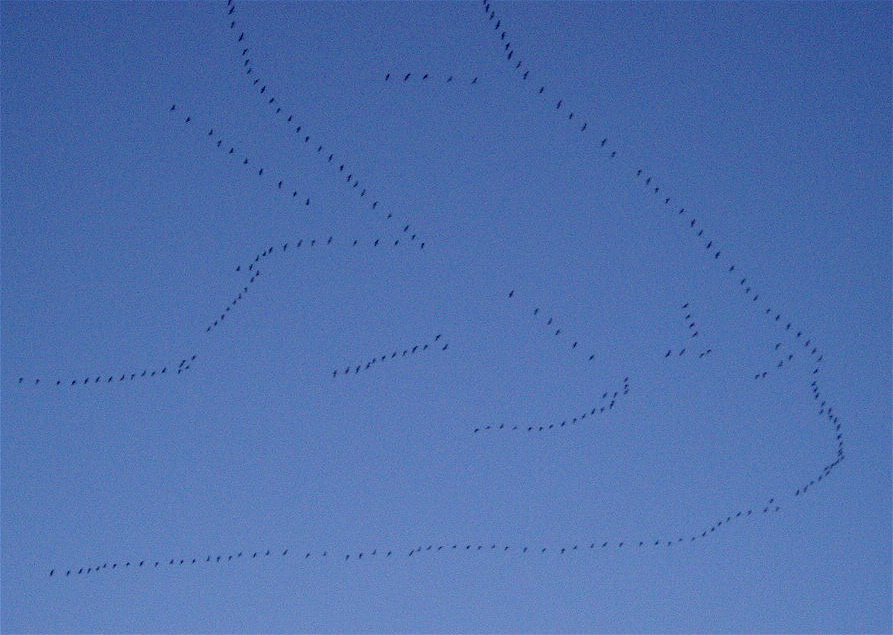
Like these Canada Geese I photographed over the Mississippi River flyway last January, Columbus was a person with far to go. Maybe he was a Thursday's Child, too. Even though the part of my ancestors who were native Americans suffered greatly as a result of Columbus' travels and landings in the New World, I can't help but have some admiration for those explorers of the 15th and 16th centuries who braved incredible hardships just to prove a point about a passage to the Far East or the existence of treasure. The bad part came later--imperialism, conquest, smallpox, suffering, political deals, and all that. In the Columbus Days of my childhood, three small ships set sail across forbidding seas carrying men who wanted to cross just because "it was there."
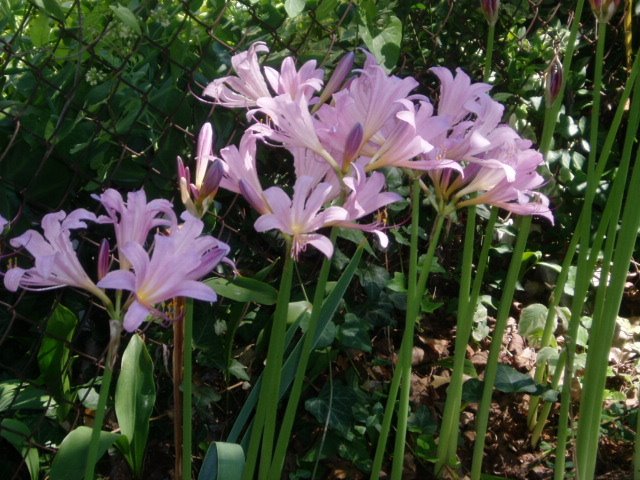
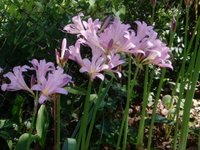
 I always thought it was cool that Mother had such a famous birthday, but she didn't have much use for the exploits of Columbus, or for celebrating her own special day. But the date never comes around without me calculating her age if she had lived past 1998--this year she would have been 92. Happy Birthday, Frances Elizabeth McElyea Burch. Thank you for giving me my start in life, on a Thursday, no less. These flowers are for you.
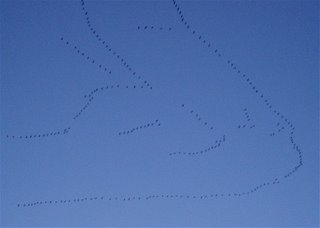 When fall migrations begin, I'm struck by how little faith I have. Wild creatures, like the geese in this photo I took last January when we spent a weekend at Pere Marquette Park near the confluence of the Illinois and Mississippi rivers, seem to travel on instinct alone, or else they communicate in a mysterious language that we humans are not privileged to know. For them, concepts such as faith, hope, or direction seem not to matter. They do what they must; go where they are called. Even in disorganized lines of flight like this flock had, they rotate leadership without apparently ever realizing (or asking) why.
But I have to ask "Why," all the time. Part of it is a natural curiosity that started in childhood and survived the put-downs of adolescence, a curiosity that drew me into journalism and also led me to explore the shelves of the bookmobile, looking for books on birds and stars and gardening and later needlework, photography and quilting. If I had been a boy I would have been allowed to dismantle windup alarm clocks and small gasoline engines just for entertainment. As it was, my Dad helped me learn to change tires and gap sparkplugs anyway.
But there's another kind of "why" that keeps me from having the kind of spiritual certainty that many friends enjoy. I don't know why we as human beings seem bound to disagree, to fall into warring camps, to distrust each other, hurt each other. Calling it a sinful, fallen world has never made sense to me--this week for Sunday School class we are studying the Creation stories in Genesis and it seems clear enough there that God considered the creation good. I'm told the next chapter will explain it all to me, but framing all the ills of the world in terms of a sinful human desire for knowledge and experience, when this curiosity seems to be inborn, is something I've always found hard to accept. Some take it on faith, but I keep asking, why?
For a long time now, I've been inclined to tell myself that my skepticism, curiosity and even doubt are not evil or fallen in themselves, but innate traits, perhaps gifts, although such are not named as spiritual gifts in Paul's writings, for sure. I imagine that well-meaning folks reading this might take it upon themselves to point out that my doubt is a form of rebellion against my Maker. I guess I disagree with that, still. Like the apostle Thomas, I feel entitled to get my news from the Source; I want to see and touch and know. Scripture makes it clear that faith is a spiritual gift, but for me, it's still a leap--a much bigger leap than the one a teenage squirrel took today as it ran up and down the garage roof more than 20 times before launching itself upward toward a flimsy maple branch a good 12 feet above. He (or she) pawed frantically, scrambled to hold on, and eventually scampered to the main trunk of the tree. Me, I'm still pacing up and down, thinking about the questions, still wondering Why.
 This past week has featured inescapable reminders of the solemn 5th anniversary of what has become known as “9/11”. For this generation and this time, it is The Day that Life Changed Forever. Indeed, a once impenetrable nation now appears vulnerable to any vicious malefactor in the world, live and in color on television. Over and over. On that day five years ago, I heard a radio report as I was dressing for work that at first sounded like a rerun of the prior attack on the World Trade Center. Then I heard an announcer say: We’ve just seen a second plane crash into the South Tower. I ran downstairs to turn on my television, just in time to hear another announcer at the Pentagon say: Something really big has made an impact here; the whole building just shuddered.
That day and the days that followed were pure hell for the people most directly affected—those who lost loved ones and those who tried futilely to rescue the perishing. And the wounds are still raw for them. For some of us in the Midwest, the images became merely surreal, once we had satisfied ourselves that no one we knew had died. For me the most ominous reminder of the danger we were in was silence—we live just a stone’s throw from the airport and are accustomed to the roar of planes landing and taking off all day and late into the night. While civil aviation was grounded, the neighborhood was eerily quiet. One night I thought I heard a plane taking off around midnight and I wanted to jump out of bed and cheer.
Although I understand the necessity, I still resent having to take off my shoes for airport security screeners. I think if they ever want to search me again (as happened in October 2001 at New Orleans when a matron groped me in front of a dozen of my students as we prepared to return home from a convention) I’ll just pull my shirt off over my head and get it over with. (I should try to remember to wear something modest underneath, maybe a sports bra, like that Olympic soccer player a few years back.) In 2001 it was no tweezers, cuticle scissors or my ever-trusty Girl Scout knife in my purse. Now it’s no moisturizer, nasal spray or even hand sanitizer. How am I supposed to avoid getting the flu while tucked shoulder to shoulder with total strangers for three hours or more? Yes, I know I’m whining. I understand this is for the greater good. I stay within the lines. I go where I’m told. Everyone is a potential terrorist, even you and me. Especially that funny-looking bald guy in short shorts who just tried to get on the plane with a cup of Starbucks coffee.
It’s easy to forget there have been other Days that Changed Life Forever. Pearl Harbor happened two years before I was born, but it left an indelible memory for my parents. President Kennedy was shot when I was a junior in college. I remember the day as a loss of national innocence—an American president could be killed, in cold blood, while the world watched. Then it was Martin Luther King Jr.’s turn, and Bobby Kennedy’s. Forget about the threat of Communism; our society was unraveling into inner chaos all by itself. During the Cold War, activists illustrated the imminence of nuclear war by setting up a doomsday clock. The hands kept moving closer to midnight, symbolic of the unleashing of a terror from which the world might not recover. Sometime after the Berlin Wall came down in 1989—another day that changed lives across the globe—the clock ticked backwards by a minute or two and the world could breathe again, or so it seemed.
The 9/11 attacks, dreadful as they were, could not move me as much as the April 19, 1995 bombing of the federal building in Oklahoma City. That assault on people who were simply working to help fellow citizens seared something in my soul forever. I’m a native Oklahoman, and I had to dash home from work and sit glued to my TV set for days. This attack was personal. Someday I’ll manage to walk through that memorial, but I can’t do it yet. Remembering that helps me understand the ambivalence New Yorkers have about what should be done with their "sacred ground." I was puzzled when Timothy McVeigh was quickly caught because his car had an expired license plate. How could he plan such an elaborate crime and then do something stupid like drive a clunker that would grab a state trooper’s attention? A psychologist explained it to me: even the worst perpetrators of the most heinous events want to be stopped, and they will make subconscious mistakes.
Sometimes I wonder what would have happened if we had gone after the 9/11 perpetrators with psychological sophistication instead of with cannons roaring. Don’t misunderstand; I don’t advocate being soft on terrorists but I think it would have been more productive to catch them and try them, than to pursue the path we are on now. Even worse, I think 9/11 did change our lives forever in one especially negative way: we no longer welcome the alien among us, much less provide hospitality to the stranger, as the Hebrew and Christian scriptures exhort us to do. Even in our neighborhoods, we trust almost no one. Any stranger, any strange behavior, arouses suspicion and fear. We are obsessed with illegal aliens and national security. Once Lady Liberty welcomed immigrants, but today we debate how best to seal off our borders. We want to preserve our way of life by denying it to anyone who is not a citizen, even visitors who have come here lawfully. Bridges are out; fences are in. The Lady's torch is sputtering. Yes, the world has changed, and not for the better.
Like all people of a certain age, sometime in my childhood I memorized the Mother Goose Rhyme designed to teach us the days of the week: Monday's child is fair of face, Tuesday's child is full of grace, Wednesday's child is full of woe, Thursday's child has far to go, Friday's child is loving and giving, Saturday's child works hard for a living....and I decided that I surely wanted to be a Friday's child...who wouldn't? Or else the child born on the Sabbath: lovely, happy and gay. I knew I wasn't fair to look at, or particularly graceful. I'd rather not be woeful or have to work hard.
Then I learned that I was indeed born on a Thursday...shortly after midnight. I managed to be an Aquarius and not a Capricorn, and a Thursday and not a Wednesday child, by just a few minutes. As my mother told it, I should have been born on that Wednesday if the hours she had spent in painful labor were to count for anything, but there I was, late for my own birthday.
And destined to have "far to go." I'm not really a believer in astrology and these kinds of charms, but there is something fitting in being a Thursday's child, because I have gone far in my lifetime, if not geographically, then spiritually and philosophically. And that is what this blog is going to be about: where I've been and where I'm going, especially in respect to faith, family and affiliations.

 Earlier this week, Norm was going through a stash of saved birthday and anniversary cards, and he came across a list of Life Goals I had made on Sept. 6, 1975. Back in those days, it was common for a workshop leader to tell you to write down your goals if you wanted to accomplish them. So on or about Labor Day of that year, while I was working part-time at a newspaper and still homesick for the Ozarks and the Rocky Mountains after moving to the Big City, I made a list of 44 items in green ink on a blank church bulletin.