 Over the years, our Christmas tree, Norm's and mine, has evolved into a family album of sorts. When I go back through photos, as I did this summer looking for images for the 40th anniversary celebration, there seemed to be a few constants for picture taking: Christmas decorations, pets, fronts of houses, and garden plants. This is our tree as it looked on Christmas morning, 2008, before we dug into the presents.

The oddly tilted foil star on top of the tree is a rescued ornament from one of my mother's housecleaning sprees. I know, Unclutterer says that when something new comes in, something old must go out. Mother practiced that. When my parents got an angel for their tree topper, this star, which I remember from my earliest days, was consigned to the trash. Except I brought it to my home and it has topped our trees for 40 Christmases.
 Mother always liked this funny little styrofoam snowman. I don't know what it's sentimental value was for her, but it is one of her ornaments I kept. The pipe cleaners are really faded, but once on the tree, it's handy to fill in one of those gaps that always appears right in front!
 My grandmother Burch gave me this plastic bird off of her tree when I was a little girl. I recall her tree in the house on North Florence only dimly. I know it had big bright lights (probably C7) and a whole flock of these birds. It goes on a high branch every year.
 Birds were popular in Norm's family, too. We acquired this one at the family auction at the Linville reunion in 2008. Unfortunately we have lost the notes about where it came from: Norm's mother, or one of his grandmothers. But it is glass, and has a spring loaded clip to cling to a branch. This was its first year on our tree.
 When I was a girl, I always looked forward to a visit with Cousin Eunice, who was a relative of my Grandpa McElyea. About the time I graduated from college, she presented me with three ornaments she had made herself, with beads, sequins and pins on styrofoam balls. One is blue, one is silver, and this red one completes the set. They go on the tree every year in her memory.
 One of the last letters I wrote to Santa Claus was on Christmas Eve of a year when snow unexpectedly showed up in the forecast. I think I was 7 or 8. I asked for a last minute change to my list, if Santa had a sled in his sleigh. Amazed, I read a note from Santa the next morning, neatly printed at the bottom of my letter. He said he was out of sleds, but he was sure I would get one for my birthday in January. And I did. Upstairs in my Dad's metal box of precious letters he saved is that letter. Not long after Norm and I were married, Daddy made this wooden replica of a 1950s sled as an ornament for me. It gets wrapped in bubble wrap when it is put away and always has a very visible spot near the top of our tree. And I start to cry every time I hang it.
  There are many more family ornaments on our tree, but in time we had to start making our own memories. Christmas of 1968, I wanted a silver and red theme for the small Scotch Pine we bought (for about $7, I think.) Being on a tight budget, we strung popcorn and cranberries, bought red and white candy canes, and finished the tree with these pine cones. We picked them up in a cemetery in Pittsburg KS about two blocks from our apartment. We invested in a can of silver spray paint that must have also been a wood preservative, for they are still sound, 40 years later. Originally they were strung with silver and red metallic ribbon but after it gave out, I restrung them with red.
 A few years after the pine cones, we were in Colorado and the church Norm served while he was in seminary had an Advent workshop. I was in charge of a children's craft room. We made these ornaments out of the old cardboard egg cartons, glue, tempera paint and gold glitter. It's another hardy reminder that one can create something of lasting beauty and memory out of the most everyday things, even things some people would throw away.
This Christmas, like all Christmases that occur after all of your ancestors have passed on, was bittersweet. But I decided that I would put everything in our storage boxes on the tree, that I wanted to remember as much as I could of our individual histories and our history together. I know of three women for whom Christmas 2007 turned out to be their last one. I got to thinking that at this time of life, there's no point in "saving" some things for next year. If they ever had value, they have value now, and I will enjoy them now, and hopefully for many more Christmases to come.
 On Saturday morning of the retreat, I followed the voice that called me to go outside for a walk. Sometimes I have to go to meetings at retreat centers, and we stay too busy, or the weather is too bad, for me to explore outside. This weekend, I wanted to feel my feet on the path, look at the sky and the distance, marvel at small things, and breathe the air. So while others were painting and singing, I left the dining hall and walked first to the river, then up the road toward the hill cabins.

The Castor River was full, but not out of its banks. The day was over cast but bright. At this point, the river flows from south (right) to north (left). My long fascination with bodies of water gets a "fix" from watching the current in small rivers like this one. As I walked back up toward the road, I noticed several vultures circling in the sky overhead. They flew silently, and I wondered if they were hunting or if they had already spied a meal.
 Small things are easier to spot when you aren't in a hurry. This insect was on the wall inside the dining hall as I exited. It is about a month (Sept. 20) until the average first frost date. I don't know how this one deals with winter, or if it even does. Humans anticipate these climate changes, but creatures, for the most part, just react to them. Certainly they have less to worry about.

One creature that will hibernate when days grow colder is this lizard, who is cold-blooded. On this warm fall day, though, it was darting through leaves, making a rustling noise. It paused on the flat rock, its markings making it invisible to predators above. If you look closely, you can see it on the flat rock in the center, just to the right of the twig that lies diagonally across the picture. (Try clicking in the photo to enlarge it.)
 Farther up the hill, I found this hawk feather lying next to the road. Another reminder of change of seasons as the bird molts and gets new feathers for winter. Hawks will perch and hunt all winter in these parts, staking out territory from a fence post or tree top. They often command several square miles, depending on the food supply. Thinking about the birds I saw this day, the vultures, a couple of hawks, several blue jays and some chickadees, I recall how the Native Americans cherished birds as messengers of the Great Spirit itself. The naturalist in me wants to return to observing such signs more intently and intentionally.
 Fall is fungus time. Toadstools, mushrooms, whatever you want to call them, are abundant. At home, Norm digs them up as they sprout along the lines of decaying roots of long-dead trees. In the deep shade of the forest next to the camp road, many small toadstools flourished. This one was most spectacular. The photo doesn't do justice to the scale of the thing. It was almost a foot tall and about 10 inches in diameter, and the yellow was brighter than the picture conveys. I've never seen such a huge fungus in my life.
 The hill section of Orchard Crest is full of native black walnut trees. I don't know if they were planted as part of the original fruit orchard here or not. No fruit trees remain, but the nut trees are everywhere. The leaves and nuts on this one made a nice contrast to the darker forest behind.
 Up close, from the other side, the bright green husks of the walnuts glow in the shade. Often this delicate yellow green is a color of spring, but in a walnut grove, it means harvest is almost here. Calling all squirrels!

Dogwoods, lovely in spring with a cloud of white blossoms along the edge of a forest, provide bright red fruit, food for wildlife, as fall arrives. In the city, the berries are prized by mockingbirds. I'm not sure which forest birds prefer them, but if I had not needed to get back to the hall for lunch and worship, I might have just waited to see.
Walking, watching, waiting, thinking, listening to the thoughts coming into my mind--for years I have done this, solitary but not lonely, as a way to try to connect with nature, the Creator, my higher power, the indwelling Spirit of life in all things. It is a way honored by many ancient people, many Native Americans. Today, I learn that this isn't laziness or "wool gathering" on my part--an accusation I often heard when I was young. It is the way of knowing of the Naturalist, as valid as reading and writing, creating logical sequences, feeling the spirit through music, organizing visual arts and space, being in motion, interacting with friends, centering in meditation. I'm grateful to Patrice, to the Southeast Gateway Women, to Orchard Crest, and to the One who led me to take this journey farther down the path of faith.
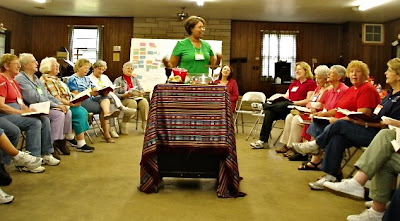 Another year, another retreat for women at Orchard Crest Camp. This gathering of 40 women from as far south as Kennett, as far west as St. Charles and from several St. Louis area churches took place the weekend of Sept. 19-20. I'm just now getting around to editing the pictures and reflecting on the experience. Here, the group gathers in a long oval inside the dining hall for the closing worship, led by Devoree C. of Webster Groves CC.
 I started loving to go on retreats when I was in college and a member of Disciples Student Fellowship. Retreat experiences have formed much of my spiritual base throughout my life. I also love going to camp, and this area retreat for women has both spiritual enrichment and a chance to spend about 24 hours in a rustic setting, close to a wilder kind of nature than I usually find in my own back yard. This outdoor chapel is the signature building at Orchard Crest Camp, but we held meetings indoors because it was damp (a week after Ike's drenching) and a tad cool.
 Cabins at Orchard Crest do have indoor plumbing, but they are still a little basic. The nearby river makes the valley humid, and the cabins are often prone to mold. Somehow, I managed to escape without my allergies being riled up. Must be part of the spell of the place.
 Our theme was "Listening for the Voice of God" and the keynote speaker was Patrice R., whom I have known for more than two decades. She noted that she suffers from impaired hearing, and suggested there are other ways to know God than listening. She led us through a review of multiple intelligences, or the different ways we receive information, or know something. Some of the ways are verbal, numerical, musical, visual, and kinetic. There are social intelligences and inward or contemplative intelligences. There is even a naturalist (observing) intelligence, which I claimed as one of my ways of knowing.
 Saturday morning we had an activity time, where women could pursue the intelligences that seemed most useful to them. This group (Patrice is at the right) used musical expression, going through the hymnbook and harmonizing a capella for close to an hour. Others enjoyed just listening, or chiming in now and then.
 A craft activity engaged the visual intelligence women. Ruth B., who is a mainstay at retreats, chose to decorate a birdhouse in the shape of a church. A large number of the women did engage in this craft. Some of them sat together at tables and collaborated, showing that social interaction was important for them.
 Others, like Ruth and Linda, here, took a more solitary, introspective approach. We had other activities including creating a spiritual autobiography. Mine is barely begun, but the process taught me something important about myself. You'd think, since I've been a writer and a "word" person all my life, I would have started writing. But I started instead with a timeline. And I was very particular about getting main years written on it, and getting items in order as they happened. Who knew I was a numbers person?
All in all, the retreat was helpful because it opened my mind to new ways of knowing God in addition to simply listening for a voice. I realized that I am primarily a word and visuals person (as my three blogs attest), but numbers (logical order) and music are also important to how I experience life and how I express myself. And kinetics, or moving around, can't be totally left out. Sometimes I just want to dance, or go for a walk. Usually I choose solitary, introspective activities over social interactions but as I've gotten older, I'm more comfortable in groups (although not yet in crowd scenes.) Yet the greatest revelation of all from this weekend was a validation of an "8th" way of knowing, that of the naturalist, or the person who observes and derives conclusions from the environment. It's possible I'm sure to be an indoor naturalist, but on this weekend, the outdoors called my name. More about that in Retreat 2008 Part II.
Today is a milestone of sorts, for the first installment of Thursday's Child was posted on August 15, 2006. This little blog of mine is more deliberate and reflective than Home Stories, and I haven't done much with it in the past year, but I haven't abandoned it. If you have checked it in the past, drop in again sometime in the next month and you will see some new things. In the past 11 months, the energy I would have put into Thursday's Child has gone into another blog instead, Compton Cares Update, as part of my contribution to a fundraising effort for my church. The updates on that project will now take less time, so I plan to spend more time on family history and reflections, my original intent when I started Thursday's Child in addition to Home Stories.
One thing that has happened is that another former member of Rogers Heights Christian Church in Tulsa found my entries about the church's closing in 2007 and wrote to me. She has since written her own impressions of the church of our childhood on her own blog. You can check it out by clicking here and here.
See you again soon.
 Orchard Crest Camp belongs to the Southeast Gateway Area of the Christian Church - Disciples of Christ. It is located east of Fredericktown on the Castor River. The cabins have bathrooms and electricity, but the entire atmosphere is still rustic. I spend the past weekend there, at a women's retreat. I've been on retreats there before, and I've counseled at summer camp. This event is about the last one of the year as the camp will close down for winter in October. Already the trees show signs of fall approaching. Yet Orchard Crest is a welcoming place, and it is blissfully out of range of highway or aircraft noise. On a warm fall night, the only sounds are from crickets and tree frogs. By day, scores of bird species still flit in the trees and skim the river. On this weekend we were given several times to meditate and write down our thoughts. Here are some of mine.
 The early morning sunlight reflects off the quiet waters of the Castor River. I'm reminded of Thoreau's famous line: "Time is but the river that I go fishing in." No fishing today, but flowing rivers always create for me a metaphor of eternity. So I walked by the river and thought about time.
Time: I don't have enough of it to do it right. I feel rushed, then I can't move. The train is coming and I just sit on the tracks and watch it coming toward me, unable to move. Hospitality needs movement and also the ability to just BE in a moment of time. I really need to let go of the concept of time, the constraints of time. Standing by the river that looks still but is inexorably moving, I wonder about the connections of time and eternity. I need to trust the reality of an eternity that can still contain my time and others' time. And still I need solitude or silent time because I can't think or feel in the midst of chaos.
 Around the camp grounds were several meditation stations. The theme was centered around sayings of Jesus. As I visited at each one, I wrote these thoughts:
Jesus is the rock. I can hear a line from a hymn: "On Christ the solid rock I stand, all else is sinking sand." There are a lot of times I have been on shifting sand, if not sinking. But rocks aren't always solid, either. The rocks in the creek bed shift and tumble. How did the vulnerable, wounded man called Jesus become a rock?
Jesus is living water. Why did he say living water? We spend a lot of money to make sure there is nothing living in our drinking water before we call it safe. We know that water makes life possible, but we don't always think of it as having life on its own. Come to think of it, aren't our bodies mostly water? I forget the percentage. And we are living. Is the water in us living water? Is Jesus' image of the living water a metaphor of the incarnation? Jesus is the living water. WE are mostly living water. Jesus is within us. As Cynthia Hale said in a sermon at Quadrennial back in 1998, All that you are seeking, you have within you. Right now.
Jesus is the vine and we are the branches. Will a twig of pipe vine be enough to remind me of the pure energy that sends out the vines of the forest: grape, pipe vine, Virginia creeper, trumpet, poison ivy, clematis? The vines run, climb, twist, furl-- tendril after tendril until frost cuts them down, and then they rest for a season before budding again. So we don't have to grow and bloom and bear fruit constantly, just in our own season.
 Jacque Foster, my pastor and the retreat leader, asked us to imagine ourselves in the place where we go for centering quiet, and then to imagine that Jesus met us there. What would we say to each other? I thought of my garden at home. I'm not sure where this following dialogue came from, but I wrote it down as it played out in my head:
Jesus: This is a lovely garden. Did you plant it?
Me: Yes...well..some of it..others did most of the work. But the plants were yours.
Jesus: I know.
Me: Why are you here?
Jesus: Why not? Aren't I supposed to be everywhere?
Me: I guess I mean, how did you find me? I forgot to invite you. I should have invited you long ago.
Jesus: Why didn't you?
Me: I think I just forgot. I'm bad about worrying or concentrating on one thing at a time, and I forget everything else. Even you. And I know I'm not supposed to forget you.
Jesus: What would help you remember?
Me: I don't know. I am getting more forgetful. Worried about becoming old. Tired. Losing interest in things I have always loved.
Jesus: What about the slant of light through the branches, or the flash of a hummingbird's wings or a sweet scent of clematis?
Me: Yes, I know you send these reminders to me. And I thank you. I thank you.
 Note: This post contains a correction added on 8/22/08.
August 26, 2007 was the final worship service at Rogers Heights Christian Church in Tulsa, Oklahoma, where I grew up. My parents, Jim and Frances, were members of another Christian church when they were recruited in the winter of 1945 to help start a new congregation on the east side of the city, across from the "new" Will Rogers High School that had opened in 1939. I recall being in the "nursery" class that met in Ms. Dessa Bedford's home, and I have a fond memory of my three-year old self drawing pictures with my finger in the condensation on her window panes the next spring. In the summer of 1946, men of the church laid a foundation for a simple rectangular building that would be worship and fellowship space until 1949, when the sanctuary (above, with the steeple) would be completed. My dad and the other men built that first church building with their own hands. When the charter closed in 1947, my parents' names were on it, as well as my grandparents Hugh and Ada Burch, and my aunt Martha, daddy's younger sister. My name is not on the charter, because our denomination (it was a Brotherhood back then!) practices believers' baptism and I of course was not yet of age to make such a decision.
 Over the next five decades, more structures would be built and added on to those two original buildings. Where we once faced north to worship, by the time of the closing, we faced south. Where once simple amber glass in casements illuminated the sanctuary, in the 1980s stained glass windows , such as this one behind the communion table at the last service, replaced them. Pews replaced the plastic chairs that had replaced the metal folding chairs that had replaced the wooden folding chairs! Paneling covered the concrete block walls. The bell still hung in the steeple, and on the last day, someone went behind the pulpit, through the prayer room, grabbed the rope and rang it, clear and true, one more time.
 Why did the church decide to close at this time? An article in the Tulsa World quoted one of the few remaining charter members as saying the membership, once in the hundreds, had declined to about 15 active folks, not enough to carry on the mission of a church or support a minister. The area was not growing, and demographics were not in favor of a progressive, mainline church in that part of Tulsa any more. After several months, they decided to plan to close and turn over the assets and property to the Oklahoma Christian Church Foundation. The Rogers Heights Christian Church endowment will support other missions and church starts, carrying on the legacy of this faithful congregation into perpetuity. I think my father, and the other founders, would approve, and when everyone gathered in a circle around the sanctuary at the close of the service, I told them so.
 In this view, five different roof lines are visible, and they show the stages of the church's growth. At the lower far right is the original little building that housed the charter congregation. It was the site of fellowship dinners, Sunday morning worship, Wednesday prayer meetings, and more. A house stood on the lot where the parking lot is now, with room for the church office and Sunday school. In that tiny building, those first winters, a free-standing gas stove heated the space. I remember backing up too close to it one cold night at a fellowship dinner and charring the backside of a new winter wool coat! The section with the steeple came next, dedicated in 1949. In the mid 1950s the three-story education building in the background was built, and the "bridge" section (the part with the higher roof line) connecting it to the sanctuary was added. The spring I was baptized, 1956*, the baptistry was a copper tank sitting on the grass between the two unconnected buildings, and my baptism took place on a Sunday afternoon at East Side Christian instead.
*Update on 8/22/08: After corresponding with Patricia Ferguson (see comment #3) we discovered a discrepancy in our memories about our baptisms. I finally went back and checked and I was baptized on Mother's Day of 1954, not 1956, at East Side. I know it was because our baptistry was unavailable, but I'm no longer sure if it was because of the construction mentioned above. Thanks, Tricia, for reading, commenting and reconnecting!
The final building addition in the foreground of this picture took place in the 1970s, expanding the first building into a proper fellowship hall with a spacious kitchen and accessible restrooms.
But a church, any church, is so much more than its buildings. Mostly it's memories for me, because Rogers Heights was my only church from the time I was on the cradle roll until I graduated from college and moved to Kansas to start my teaching career. This is where I learned the names of 66 books of the Bible and understood that the Bible was a library of writings of faith, not simply an infallible "word." This is where I learned to sing "Jesus Loves the Children of the World"--red, brown, yellow, black and white. This is where, after I was in high school, I taught the second grade Sunday school class and played piano for singing in Children's church, slipping back into the sanctuary just in time for communion and one of Lloyd Lambert's sermons. After I was in college, I was invited to give the Youth Sunday sermon one year.
As children, one of the boys and I kept the church librarian, a single lady named Edna Mary Letson, in poverty as she undoubtedly bought with her own money the two new books a month she added to feed our appetites for new stories to read. (At the church's 50th anniversary in 1995, Norm and I visited and I went up to the library in the educational building and found the row of orange-bound biographies of famous people. I opened one and pulled the card out of the pocket and yes, there was my name!) Knowing that my name was still on a card in a book in that library somehow made me feel still connected to Rogers Heights, although my last contact with most members of the congregation was in the summer of 1968 when a group of the women gave me a bridal shower. Shortly after that my parents moved and transferred to East Side, which was closer to them.
Because of Rogers Heights, I entered adulthood with a useful grounding in biblical history and the Christian faith. I knew my baptism had not been into one congregation, but into the universal church. During the next seven years of college and work, I would undergo the usual periods of young adult questioning, and doubt, and begin the recovery and re-creation of my faith. Because of the love and encouragement I had always known at Rogers Heights, I continued to attend church, first in Fayetteville, Arkansas, and then in Pittsburg, Kansas. Somewhere in those early years at Rogers Heights, I got the idea that if I persisted, even if I thought I had lost touch with God, God would somehow find me.
It was a very bittersweet experience, the closing and decommissioning of my childhood church. I found out about it in an e-mail my cousin sent me by chance, mentioning the article in the Tulsa World that appeared on Aug. 18. Although I wanted to be there, I would not have made a special trip, but Norm and I found ourselves in Tulsa that week anyway when the same cousin's mother-in-law died and Norm was to conduct the memorial service. It seemed a sign that we should stay over, and I'm glad that we did.
The "little church on the corner" belongs to history now, but it will live on in the memories I have and in the bequest it has given to the larger church. I have said that the death in my cousin's family and our trip to take part in the service had seemed a sign that we should be there for the closing of Rogers Heights. Imagine my astonishment when, at the close of the service, we all repeated the same words of Isaiah that had been the text for the service for my cousin's mother-in-law three days earlier:
For you shall go out in joy,
and be led back in peace;
the mountains and the hills before you
shall burst into song,
and all the trees of the field
shall clap their hands.
Isaiah 55:12
 This week is an anniversary for this blog and its companion. The first post to Home Stories appeared on Aug. 11, 2006 and the first entry on Thursday's Child is dated Aug. 15, 2006. So a year has passed, and I have learned that blogging requires some self discipline, energy and creativity that I don't always have. But I'll continue whenever something needs to be said.
August 15 is also the birth date of one of my great grandmothers, Paralee Belle Morgan Paris. She was born in 1864 and she died in 1962 at the age of 98. For all of the 19 years of my life to that point, she was old, forgetful and eventually an invalid, but stories about her younger days are intriguing. When she was barely 20, she married a tobacco farmer named Roscoe Paris, of whom her parents did not approve, in 1884. Evidence suggests an elopement. She apparently was a feminist before her time. When her younger daughter (my grandmother) was born in 1890, she told Roscoe "no more babies." Belle had been the oldest of 11 and she didn't want to be bedridden from childbearing like her mother. The family moved to Oklahoma Territory in 1903 and became part of the pioneer settler movement that created the 46th state. I have much more to write about her when I get the 4 Great Grandmothers project underway. For now, happy 143rd, grandma Belle!
What's with the numbers in the picture, you ask? Well, Norm and I were in the Missouri Botanical Garden gift shop a month or so ago and we purchased the lovely ceramic tile numerals and the frame to hold them as an early anniversary (or belated housewarming) present for ourselves. Six years after our move to this address, we decided to upgrade and personalize our house number. So now you know where we live.
 Back in July, my cousin Mike celebrated one of those milestone birthdays, and Norm and I went to Tulsa to join in the festivities. There were several presents, but the one Mike seemed to enjoy playing with the most was his new grandson, Jason, who was 6 weeks old at the time of the party. When I look at this picture, I'm reminded of myself at 4 or 5 years old, meeting Mike when he was a baby and falling in love with him at first sight. It's amazing to think we have both made it to this age. Happy 60th, cous!
 Jason is a happy, friendly baby who took time out for a nap on his grandma Debbie's chest while the rest of us indulged in the barbecued brisket, pulled pork and spareribs that Mike cooked earlier in the day in his smoker. Now that's a rare man who will cook the main course for his own birthday dinner!
 Jason even spent a little quality time with cousin Judi. Here he looks a little dubious. He's probably not used to seeing that much gray hair! We all enjoyed the hospitality of Debbie's sister Cari and her husband, Jack, as well as the company of their daughter Amy and her son Lucus (4 months) and Mike and Debbie's daughter Felicia and her husband Jonathon and Jason's older brother Kevin, plus Debbie and Cari's brother Tim. Debbie has some stories on her blog (Debide's View) about family and baseball which explain why Tim was in town for that week as well.
We are so glad we got to visit with all of Mike and Debbie's family on this trip. Mike and I grew up as only children in Tulsa, separated by 4 years in age. Our families celebrated holidays as well as spent many Sunday nights together. Originally I had four cousins: Jerry died in military service during the Vietnam era, and the two girls who grew up in California, Linda and Robin, have pursued separate life paths: I haven't seen either of them in decades, which I regret. For all practical purposes, Mike is my only living relative, and the only person living with whom I have memories of a shared childhood. So both of his grandsons--Kevin and Jason--are precious to me.
In subsequent posts, I'm going to look more closely at (mostly my) family history and trace some of the the Burch and Brown, McEleya and Paris family lore. I got a start on our return trip from Tulsa, as we explored courthouses and cemeteries in a search for two of my four great-grandmothers. But that's the next story.
Just a short note that I finally got around to adding some favorite blogs to the Links section in the sidebar. Among them are Doug's blog commenting on Southern Gospel; my pastor's blog, a blog by Norm's niece Debbie and a brand new blog by my cousin Debi. I check these every day and enjoy them all. To add these links in the template I'm using actually involves tinkering under the hood of the blog template and correctly typing one line of html tags for each link-- so I'm feeling rather smug that I accomplished the task and they actually seem to work!
This morning in a group at church, my pastor mentioned the post about "Life Lists and Lessons" . Then two other people in the group piped up that they had read it, too. Wow. It's great to know that I'm not just throwing words (and pictures) into cyberspace the way a person stranded on a deserted island tosses a note into a bottle and sets it adrift. Please, though, if you have any reactions, suggestions, questions or comments--feel free to leave a comment or even send me an e-mail. Part of the blog experience is to have a conversation, so if I've said anything worth talking about, please let me know, now and then. Otherwise, I feel like I did at summer camp in the seventh grade, waiting for mail call and no letters for me today.
If you wish to leave a comment, just click on the "comment" link below each post and simply type in the window on the page that comes up. You don't need a Blogger/Google identity to comment. You can post as Other (click the button near the bottom of the comment page) leaving a first name or nickname. Or you can post as Anonymous and let me guess! Click the orange "Publish Your Comment" button and you are done. Your e-mail address is never collected or posted. Or if you have a reply that you prefer that the rest of the world not read, you can send me an e-mail. If you don't know my address already, there is a link for e-mailing me on my profile page. Just click on "view my complete profile" near the top of the blog to get there.
Now that the school year is over (yes, I came out of retirement to teach one class--silly me) I hope to publish on Thursday's Child more often. Talk to you soon!
 Earlier this week, Norm was going through a stash of saved birthday and anniversary cards, and he came across a list of Life Goals I had made on Sept. 6, 1975. Back in those days, it was common for a workshop leader to tell you to write down your goals if you wanted to accomplish them. So on or about Labor Day of that year, while I was working part-time at a newspaper and still homesick for the Ozarks and the Rocky Mountains after moving to the Big City, I made a list of 44 items in green ink on a blank church bulletin.
Of course, I lost track of the list and hadn't seen it in at least a decade, but a month or so ago I had wondered about it. Maybe that thought is what helped bring it to the surface. Anyway, I had a good laugh at some of the items, and felt nostalgia for some others. If I had worked at the list and accomplished one a year, I could look forward to total victory sometime in the year 2019, or around my 76th birthday! But the truth is, some of these goals have long been out of reach, and others have been supplanted by different dreams. Here is the list, with those that I did accomplish marked with an asterisk:
1. Climb to the top of Gray's Peak, Colo. (I got to within 1300 feet of the summit in 1972 and wanted to go back and finish the job. Alas, not.)
2. Camp in the Bridger Wilderness in Wyoming.
3. Visit Alaska and Hawaii.
4. Visit all 48 contiguous states. (So far I've made it to 25.)
5. Drive a truck.
6. Publish a book.
*7. Float on the Current River and the Buffalo River.
8. Publish a newspaper
9. Ride cross-country on a bicycle.
10. Have two children.
11. Live on a farm of 10 acres or more.
12. Go up in a hot air balloon.
13. Visit Yellowstone, Sequoia, and Grand Canyon national parks. (I went to the Grand Canyon with my parents in 1960, but wanted to go again and to the North rim this time.)
14. Ride the Delta Queen to New Orleans. (After taking the Huck Finn to the JB Bridge, I think that's as far as I'll go.)
15. Hike the Appalachian Trail. (Will maybe a mile, if I can manage it, count?)
16, Go on a cross-country ski trip.
*****17. Make a quilt. (At last, something!)
18. Refinish an old piece of furniture.
19. Have a craft or yarn shop.
20. Visit Mexico.
*21 Visit Ireland.(I was there in 1967. But I want to go again.)
23. Lead a Girl Scout Troop.
23. Own or manage a camp.
24. Become a campcraft instructor.
25. Qualify for Red Cross First Aid or Lifesaving. (Got the first aid, also CPR. No water stuff.)
26. Get a first class radio license.
27. Operate a ham radio.
28. Learn how to tune up a car. (Kind of obsolete now. I did manage to gap some spark plugs.)
29. Read all the works of William Faulkner.
30. Raise Christmas trees.(On that 10-acre farm, no doubt.)
31. Study herb lore and raise a herb garden. (Do pots of mint and lavender and basil count?)
32. Build a greenhouse.
33. Build a tree house.
34. Trim a tree.
35. Raise all my own fruits and vegetables.
36. Become a vegetarian.
37. Go on a round trip to the moon. (Remember, the first moon landing was only 6 years earlier.)
38. Write a novel.
39. Win a literary prize.
40. Visit an Indian reservation.
41. Visit the birthplaces of my parents, grandparents and great-grandparents. (So far, the parents.)
42. Get a copyright or a patent.
43. Build a log cabin.
44. Ride a train through Glenwood Canyon, Colo.
Wow. What ambition. I'm amazed that I once had such athletic inclinations. A lot of these ran to outdoor activities, or gardening, or self-sufficiency, which was a big theme in the 1970s. As you can see, there aren't many asterisks. But I did set other goals and accomplish some of them. That is a story for another day. The photos here are from the campus of my alma mater, the University of Arkansas. Near the old Student Union, a bald cypress that was there in the 1960s during my student days still broods over the sidewalk, and it now has a plaque at its base, for special recognition of its longevity. If trees could only talk, the tales it could tell! And the Arkansas tradition of Senior Walk continues, with the name of each graduate etched in concrete. I'm there twice; below is my name from 1966 when I got my master's degree. It's not yet an epitaph; there's more to go.

 From Don and Kay in Garden City comes this photo of one of mom Linville's amaryllis plants (more correctly, a descendant thereof) blooming in their sunroom on Monday of this week. As Don noted, just in time for her birthday. Bertha Williams was born on this date 101 years ago in a Western Kansas dugout. A true pioneer, she loved flowers and grew an amazing variety of them despite the challenges of surviving in a a dry, windy, hot, freezing, dusty, unpredictable climate. The amaryllis was only one of the beautiful things that she passed on to her children and their children over the years. And she was the best mother-in-law I could have ever hoped for. Nine years since her passing, we still miss her.
 In Central Missouri, there is a retreat center known as Rickman Camp and Conference center, which is owned by the regional Disciples of Christ church. I spent the weekend of March 23-24 there with 21 other women. The rest of the story of the retreat can be found on Home Stories. About 11 a.m. on Saturday, I explored the prayer trail, and found all kinds of small details and wonders to photograph as I walked. I was practicing being in the present moment, trying to be open to what my heart or soul might have learned during the retreat. Our leader, an artist, talked about coming back to her art after many years, finding it a gift she could use for ministry.
 Over the years I have explored many gifts, including writing, quilting, photography, and others. But one sensibility I've had since I was very young is an appreciation for the natural world and a desire to experience its myriad changes and moods.
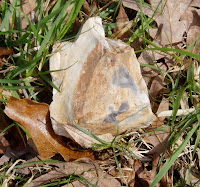
I've collected rocks since I was in grade school (but I left this one in place after taking its picture.). I've identified trees and flowers and birds and tracked the stars.
 The night before I took this walk, I had gone outside for half an hour to just sit on a bench in the darkness. Something the leader had shared with us had reminded me of accounts I had read of the old Cherokees and other Native Americans who said they needed physical contact with the ground in order to connect with the Great Spirit. I took off my shoes and socks and let the coolness of the ground seep up through my feet.
 As I sat absorbing the silence, I began to hear the peeping of little frogs that come out as a first sign of spring. The next day when I shared that, people seemed surprised that anyone would know what had made the sound. I'm wondering if this is a gift I can use again at this stage of my life. What does it mean that I see the delicate web of a spider in the woods by the prayer trail, or a lichen-covered stump?
 A hillside near an outdoor chapel on the Center's grounds is covered with huge, ancient cedar (actually, juniper) trees. They were about to bloom and release a ton of pollen into the air, much to the dismay of anyone with allergies. Even the tiniest thing in Nature can have a profound effect on humans. After I came in from sitting in the night, my feet in contact with the ground, my ears open to the silence, I wrote this:
 All the world is quiet except for the buzzing of a street light, the click of a cardoor and someone rolling a suitcase up the walk. And a far off roar of traffic on the highway. And the FROGS! So faint...spring peepers, that falsetto soprano chorus... first night sounds of Spring.
I have to be grounded--I could never live in a high rise, or even on a second floor with a lovely deck. I need the ground to walk on. If only I could be limber enough again to sit down on it, kneel on it, lie on it, and feel the energy of the Earth flow into me, rekindle my spirit. BUT I'm not yet ready to be IN the ground--because I also need to see the sky.
 Some 30 or 40 years ago, we hummed a Beatles tune: will you still need me, will you still feed me, when I'm 64? That was the age at which we youths expected to become old folks, tottering a bit, needing someone to monitor our meds and take away our car keys if we strayed too far off the center line.
Today, I turned 64. That's 8 times 8, as I learned my multiplication tables in third grade. But as I thought about it, I decided to look at my life so far as 4 times 16. Once, 20 years were supposed to define a generation, but today, with the rapid rate of technological change, a generation is closer to 16 or 18 years. So I tried to break the years into generational, or 16-year segments.
1959--My sixteenth birthday. Most girls of my generation expected a special party, but nothing like the "Sweet Sixteen" social coming-out galas that are commoplace today. That year, there was no party. My grandmother McElyea died one day before my 16th birthday, and her funeral was held a few days after. Mary Paris McElyea left me a legacy of a trunk full of hand-made quilts and a fistful of prized family recipes. I wish I could have claimed additional items at her estate sale, like her full set of Fiesta Ware. But mother did save for me her Apple Blossom china and her Vintage pattern silver plate. When I was about 7, Granny Mc helped me make a simple doll quilt by hand. Unfortunately my desire to make quilts of my own didn't emerge until the late 1980s, some 30 years after her death. But I inherited any talent I have with a needle from her. (The wall quilt above is a Lone Star I made a few years ago that was exhibited at the 2005 Flower Valley Quilt Guild show.) The one bright spot of this birthday was getting a phone call that told me I had been selected to attend a national Girl Scout encampment, called Roundup (kind of like the Boy Scout Jamboree, except these Roundups don't happen any more) that would be held in Colorado Springs in July. So it was a bittersweet birthday when I was 16.
1975--My thirty-second birthday was observed in St. Louis, where I was unemployed and taking an editing class at a local junior college in order to network and try to find a job in journalism. In the 16 years since 1959, I had gone to that Girl Scout camp, attended college and earned a master's degree, obtained a college teaching job in Kansas, met Norm, gotten married, moved to Denver while he went to seminary and moved to St. Louis when he got a publishing job. That was an action-packed 16 years. My dog I had had since I was 10, Rags, had died in 1969, and later that summer, on our first wedding anniversary, Norm and I adopted a puppy we named Sandy from our friends John and Nancy Sanders, and Sandy would brighten our lives for almost 17 years. In March of 1975, I got a proofreading job at a weekly newspaper, which was the start of my journalism career.
1991--How did I get to be 48 so soon? I'm almost 50! I really can't remember how I celebrated this birthday, except later that month, Norm had a wreck on his way to work and I waited in the emergency room while they verified a couple of broken ribs. These were stressful years involving work and my parents' health. In 1989 my father died. My mother had difficulty coping with the details of living alone, but she wouldn't consider moving to live with us, or to a senior apartment. Check stubs from those years reveal that I flew to Tulsa about once a month on weekends to help her with insurance forms, balance her checkbook, stock up on TV dinners, go to church. I had been teaching writing courses at a university since 1987, after working in newspapers, magazines and public relations. Norm had been pastor of a church since 1985. Sandy had passed away in 1986 and later that year we adopted Suzie, a 5-year-old Lhasa-Poo cross, who would be with us until 1995. The 1990s were a dizzying round of emergency trips to see our parents, frantic grading of final exams while someone was in the hospital, all while trying to maintain friendships and a life. By the end of the decade, we had said farewell in this life to both of Norm's parents, one of his brothers, one of his sisters and my mother.
2007--Here I am, at 64. When I turned 50, I got my ears pierced and started collecting earrings. I kept on teaching and started advising a college newspaper in 1994, the same year mother was diagnosed with Alzheimer's. I joined a quilt guild and attended a summer writing workshop in nonfiction. Norm and I began taking short trips to state park lodges where we could indulge in bird watching. In 2003, Norm retired from preaching. In 2006, I retired from full-time teaching but kept a part-time job with the student newspaper. I started writing what I call the Memoir Project and if I finish it, it will be a family and personal history, starting with my four great-grandmothers, 3 of whom were known to be quilters. And we have been blessed with surrogate parenthood: for at least a decade, we have had Doug in our lives as the son we never had. And now we have his partner Matt, also, and their dog Sam. We have enjoyed volunteer projects and have lots of travel plans.
Where from here? Well, if the past is any predictor, the next 16 years should be quite a trip. If I'm still blogging in 2023, I'll be 80, and I'll let you know how the 5th generation is doing.
 For the month of November, this cornucopia has been the seasonal banner at our front step. Soon it will be time to put up something suitable for Christmas, but the image of natural abundance in the picture reminds me that I need to make a list of some of the things I am most thankful for.
Back in 1999, I read a small book titled Simple Abundance by Sarah Ban Breathnach. The premise was simple...too simplistic, some would say. The idea is to become aware of one's blessings, to cherish the present moment and see what one has to be grateful for. Cultivating this practice of gratitude has become my most reliable spiritual discipline, since I tend to falter when it comes to some of the others. And even though the Simple Abundance idea has gone on to become a huge industry, that basic practice of gratitude...finding five things a day that I am thankful for, each day, without duplicating yesterday's list...has sustained me when I have felt overwhelmed by work or commitments, saddened by events beyond my control, discouraged by my own weakness, or just plain tired. If I were to compile a condensed Simple Abundance list for 2006, it might include the following:
- Retirement, and the joy of sleeping in--sometimes.
- Water exercise
- Reading club
- Blogging
- Seeing Carnall Hall restored and thriving (see account on Home Stories)
- Walking on the beach in Ft. Myers, Fla.
- Doug's PhD hooding ceremony.
- All of Doug's family and Matt's family and many friends at our house for his graduation picnic in May
- Being able to walk right after arthroscopic knee surgery
- The hum of neighborhood generators through the night during our 5-day storm blackout.
- The kindness of neighbors.
- Hummingbirds at the feeder
- Quilt stamps to put on letters
- Online banking to save postage
- Sloppy Poodle kisses from a pup named Sam
- The best neighbor in the world, Barb, to share a driveway with, and her 15-year-old terrier, Barnabas.
- All of the Linville sibs and many of their families at the reunion in June
- The World's Largest Ball of Twine is really that.
- Highways
- Non-stop flights
- high Speed Internet Access, and the means to pay for it.
- The Cardinals win the World Series
- My student newspaper staff takes 2nd in the nation
- A 13-year-old Van keeps truckin'
- Sunlight
- Rain
- Our outdoor and indoor garden
- Christmas Cacti blooming two months early
- 250 Trick or Treaters on Halloween
- Passing the Peace on Sundays at Compton Heights
- Norm
- Life, here and now, every day.
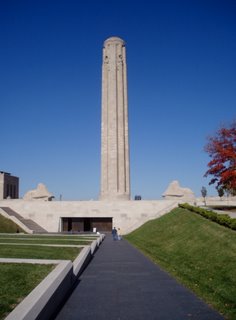 November 11, 1918-- Armistice Day. The truce that ended World War I, or as it was known in that long-ago time, the War to End All Wars. Down through the years, the date has become a federal holiday, and now is known as Veterans Day, to honor all those who have served in all of the armed services in any of America's Wars since WWI. The photo is of Kansas City's striking Peace Memorial, recently renovated and re-opened to the public. It has a new museum underneath. Originally known as "the War Memorial," it was built to commemorate WWI. At some point, Kansas Citians renamed it to honor the 20th Century's quest for peace instead.
At at time when our nation is caught between a rock and a hard place in Iraq, it might be a good time to pause and think about the sacrifices of those WWI doughboys who went to Europe and endured unimaginable wounds, mustard gas, and worse. Every time America has to go to war, personally I would hope that the exercise would leave the world a better place, in addition to securing greater security for our nation and a better climate for peace. They say that only 12 to 15 veterans of WWI are still alive, and most of them are over 100 years old. Veterans of WWII are dwindling, too. My dad, whose draft notice appeared in the mailbox the same morning I was born in 1943, has been dead for 17 years now. When I sorted through his keepsakes I found his Army field manual and several medals for expert marksmanship. An old knee injury from high school football kept him out of the Infantry, and a field surgeon sent him home to my mother and me just before his outfit left to attack Rommel in North Africa. Because he didn't see combat, he wasn't a veteran, but he was proud of his service. If he were alive today, he would be watching the televised news reports from Iraq and Afghanistan and probably would say something to the equivalent of "what are they thinking?" in regard to the political leadership, and he would be supporting the troops in their impossible mission. I can do no less than that.
What if there were a Reconciliation Commission for Iraq? The mission there today has become stabilizing the nation so that the Iraqi government can function without being overwhelmed by various factions, including insurgents and warring religious and ethnic sects. The situation might be better handled if the troops could be augmented by a proactive effort to begin to heal the wounds in that country, an effort led by the Iraqis themselves. After apartheid was ended in South Africa, a Reconciliation Commission investigated the various imprisonments and wrongs that took place and helped people find solutions that didn't involve civil warfare. Would something similar work for Iraq? Is anyone willing to try some genuine peace-keeping in addition to maintaining a security force? On this Veterans Day, former Armistice Day of the war to end all wars, it's worth a thought.
 Yesterday I tried to write an Election Day post, but the upload feature wasn't working. Probably all those bloggers out there hogging the bandwidth! This photo is of a St. Louis landmark, the Old Courthouse. It was a working federal courthouse throughout the 19th Century and into the 20th. The slave Dred Scott lost an appeal for his freedom before the United States Circuit Court meeting in this building in 1854. A 25-year-old Hungarian immigrant named Joseph Pulitzer bought a newspaper in a bankruptcy sale on the steps of this courthouse in 1878, and merged it with another one he owned to found the St. Louis Post-Dispatch. Now we all know that the Dred Scott decision was ultimately superseded by President Lincoln's Emancipation Proclamation, and the ratification in 1865 of the 13th Amendment to the Constitution. And earlier this year, the Pulitzer family sold the Post-Dispatch to another publishing group. My point: even the great moments of history don't last forever.
I like the clean, classic lines of The Old Courthouse in downtown St. Louis because it reminds me of the somewhat classical ideals on which our country was founded: life, liberty and the pursuit of happiness, a rule of law, an abhorrence of dictatorship or monarchy, equal justice for all. And regularly we hold elections to choose our representatives to carry out these ideals. Since my first election in 1964 (which is the only time I ever voted absentee) I have missed only one opportunity to vote wherever I have lived. Often I find myself on the losing side (I start out in blue states and they turn red, seemingly overnight, after I move there) but I have never subscribed to the cynical theory that my vote doesn't count. You couldn't keep me home on election day with a flotilla of tanks in the street.
Last night I stayed up to watch the election returns. It was a late night; the victor in Missouri's contested Senate race spoke after 1 a.m., followed by a concession speech from the incumbent. The margin of victory was finally about 3 percent, although at the time Claire McCaskill was declared the winner, only about 25,000 votes separated her from Jim Talent. This is one of those extremely rare years that "my" candidate actually won, but I have to confess I have been following the excitement of the political process since I was about 9 years old.
During the hot summer of 1952 in Oklahoma, I remember the political conventions being broadcast, seemingly gavel-to-gavel, on radio (we didn't have television until I was 14.) I would be sent to bed at the usual time but my parents kept the radio on, and I kept sitting bolt upright in my bed, with the door ajar so I could listen to the speeches and above all, the roll call votes. There was something thrilling about hearing "and the Great State of Illinois....casts its ...votes for...Governor Adlai Stevenson!" Or the chants of "I Like Ike" coming from the Republicans as they nominated the general who promised to "go to Korea" and end that conflict. My childhood diary entries reveal that summer I became hooked on politics and that interest probably foreshadowed my interest in journalism. Many of my acquaintances are suspicious of those network news pundits who sit at what nowadays resembles an aircraft carrier control desk and gleefully track the Red and Blue states. Last night their excitement was probably interpreted as a liberal bias. Some of them are liberal, to be sure. But most of the excitement is from an adrenaline rush of reporting on something that is ever-changing, quick moving, novel and historic all at once.
There is nothing else on earth like an American election, even with all the flaws in our political system that surface from time to time. Yesterday morning I spent an hour in a line to use one of the three brand spanking new working computerized voting machines crammed into our tiny precinct headquarters. It was not yet noon and I was voter number 349 in a village of 1500 souls, not all of them of voting age. Turnout in our county was close to 70 percent. People cared about the propositions on the ballot, especially those to protect stem cell research and to raise the minimum wage. They also cared about their local legislators and the Senate contest.. One woman using a walker was attended by her son, a 50-ish fellow in a gray sweatshirt who talked with us in line. I'm pretty sure he didn't vote the way I did, but I liked being there in line with him, anyway. And he had brought his mother to vote. Another man came in a wheelchair. Young people came on their lunch hours from work. Black and white, old and young, Republicans and Democrats and Libertarians and Independents. Americans. As deTocqueville noted: here, the people rule. I can't wait for 2008.

 Over the years, our Christmas tree, Norm's and mine, has evolved into a family album of sorts. When I go back through photos, as I did this summer looking for images for the 40th anniversary celebration, there seemed to be a few constants for picture taking: Christmas decorations, pets, fronts of houses, and garden plants. This is our tree as it looked on Christmas morning, 2008, before we dug into the presents.
 Mother always liked this funny little styrofoam snowman. I don't know what it's sentimental value was for her, but it is one of her ornaments I kept. The pipe cleaners are really faded, but once on the tree, it's handy to fill in one of those gaps that always appears right in front!
 My grandmother Burch gave me this plastic bird off of her tree when I was a little girl. I recall her tree in the house on North Florence only dimly. I know it had big bright lights (probably C7) and a whole flock of these birds. It goes on a high branch every year.
 Birds were popular in Norm's family, too. We acquired this one at the family auction at the Linville reunion in 2008. Unfortunately we have lost the notes about where it came from: Norm's mother, or one of his grandmothers. But it is glass, and has a spring loaded clip to cling to a branch. This was its first year on our tree.
 When I was a girl, I always looked forward to a visit with Cousin Eunice, who was a relative of my Grandpa McElyea. About the time I graduated from college, she presented me with three ornaments she had made herself, with beads, sequins and pins on styrofoam balls. One is blue, one is silver, and this red one completes the set. They go on the tree every year in her memory.
 One of the last letters I wrote to Santa Claus was on Christmas Eve of a year when snow unexpectedly showed up in the forecast. I think I was 7 or 8. I asked for a last minute change to my list, if Santa had a sled in his sleigh. Amazed, I read a note from Santa the next morning, neatly printed at the bottom of my letter. He said he was out of sleds, but he was sure I would get one for my birthday in January. And I did. Upstairs in my Dad's metal box of precious letters he saved is that letter. Not long after Norm and I were married, Daddy made this wooden replica of a 1950s sled as an ornament for me. It gets wrapped in bubble wrap when it is put away and always has a very visible spot near the top of our tree. And I start to cry every time I hang it.
 A few years after the pine cones, we were in Colorado and the church Norm served while he was in seminary had an Advent workshop. I was in charge of a children's craft room. We made these ornaments out of the old cardboard egg cartons, glue, tempera paint and gold glitter. It's another hardy reminder that one can create something of lasting beauty and memory out of the most everyday things, even things some people would throw away.


